

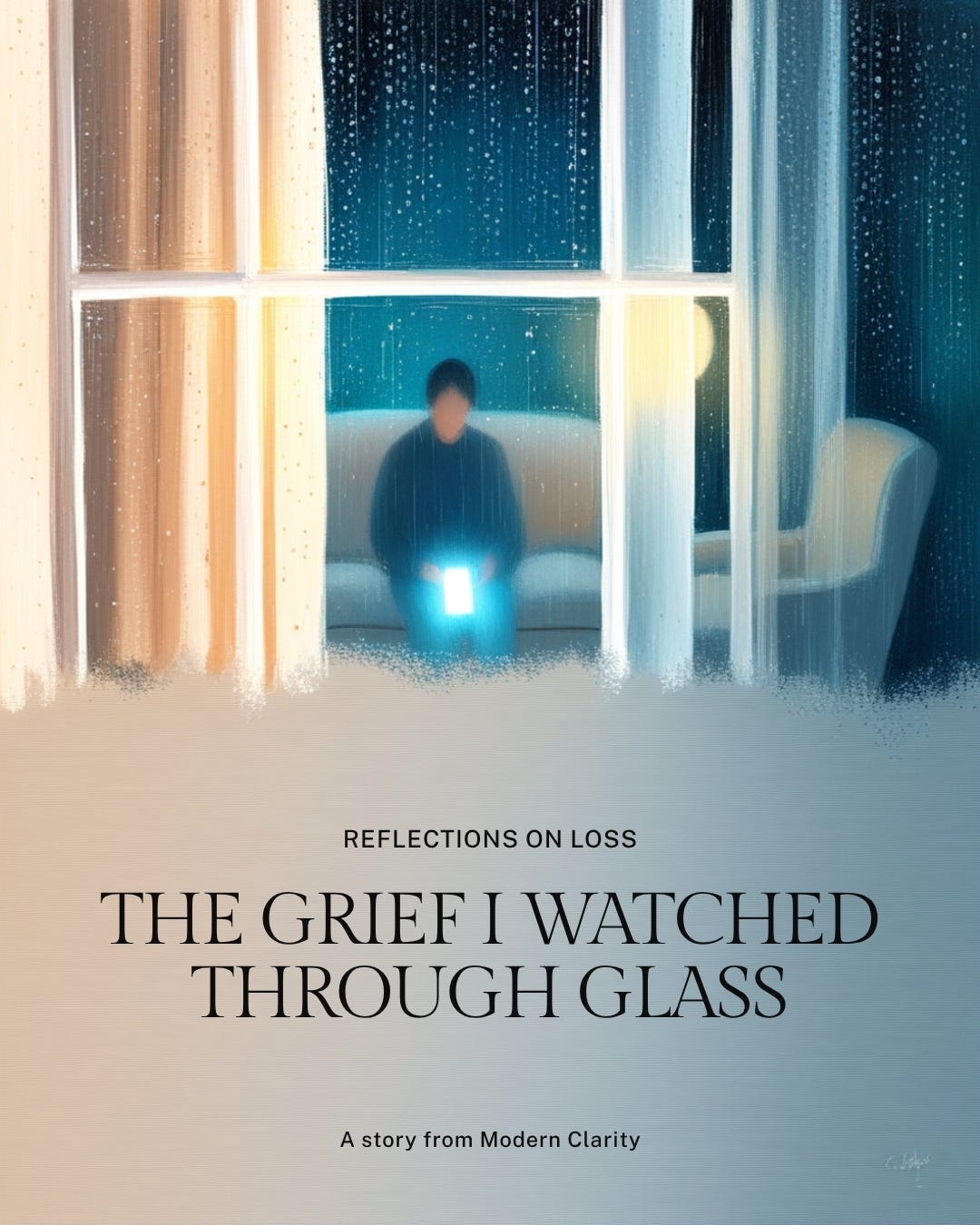
“What is the cost of our technology?”
Our teacher asked us on the last day of engineering college, while we waited to say goodbye. Half the room was filming him on their phones. The rest were somewhere else, scrolling, chatting, laughing at something on a screen. Nobody answered. I heard the question, filed it somewhere in the back of my mind, and forgot it there.
Because I had a life to get back to. And my life, by then, lived inside a five-inch screen.
My life revolved in and around my phone. I ate with it propped against a glass. I answered emails in the bathroom, replied to messages at red lights.If a moment ever went quiet, I filled it with other people’s lives. Their vacations, their promotions, their beautiful,curated everything. Next to them, mine looked like nothing.
* * *
My grandmother lived with us through all of it. She was part of my days the way the furniture was: always there, easy to walk past. In the evenings she’d pat the empty space beside her. Come. Sit. Tell me about your day. And I would sit, sometimes. But the phone would be in my hand, and my eyes would be on the phone, and I’d answer her without hearing her. “Hmm. Really.” She’d talk, and I’d nod at a screen. After a while she stopped asking twice.
I told myself there would be time. There is always supposed to be more time.
* * *
Then one morning my mother was screaming my name from her room. I ran in still holding the phone, mid-reply to someone whose name I don’t remember now. My grandmother was on the bed, and she was gone, and the last thing I had said to her the night before was “hmm.” I hadn’t even looked up to say it.
I thought losing her would change me. It didn’t. Three days after the funeral, I was sitting on the floor of her empty room, crying in a way I hadn’t cried since I was a child. My phone buzzed. I picked it up without thinking. My thumb knew the motion better than my mind did. And there, mid-sob, was a video of a stranger’s dog wearing sunglasses. I watched eleven seconds of it before I understood what I was doing. Then I put the phone face-down on the floor and looked at it for a long time, the way you’d look at something that had bitten you. That was the moment I should have understood what owned me. I didn’t. I picked it back up an hour later. I just kept looking down.
* * *
My family, worried, planned a trip to a jungle resort to pull me out of the fog. They went ahead. I would follow after one last meeting; I couldn’t move.
On the safari road, near dusk, I passed a car pulled over with a freshly changed tyre and an old man standing beside it. Something made me stop. It was him. My teacher, older and smaller now, the same steady eyes.
“Sir,” I said. “You remember me?”
He took off his glasses, smiled, and tapped my arm as if no years had passed. My phone buzzed in my hand. It buzzed again. I silenced it, apologising. “This thing,” I muttered. “Such a trouble.”
He looked at me for a long moment. “Then get rid of the trouble,” he said. He wasn’t smiling now. We said goodbye.
* * *
I got back into the car. It wouldn’t start. I turned the key again and again. Nothing. I reached for the phone to call for help. The screen was black. The battery had died, and I had no charger. The car wouldn’t move. The phone wouldn’t turn on. I was stuck, and I had no way to call for help.Alone on an empty jungle road as the light began to go.
At first I panicked more about the dead phone than the dead car. My hand kept reaching for it out of habit, finding nothing. When there was truly nothing left to do, I started walking.
And the world I had been ignoring for years was still there, waiting.
The sun was setting behind the hills, slow and enormous, spilling gold across the entire sky. I stopped and stared at it. I could not remember the last time I had watched the sun go down without reaching for my phone.
The trees leaned and whispered as the wind moved through them. There were flowers along the road I would have driven straight past without ever seeing, small, bright, just there, asking nothing.
As the birds flew home in tired, scattered lines above, they exchanged calls, their voices a gentle murmur in the sky. It sounded like happiness. It was the kind of deep contentment that settles in after a day filled with satisfying labor. The whole forest seemed alive with the rustling of leaves and the chirping of birds. A symphony of a thousand tiny sounds – chirps and rustles – filled the air, sounds I had been oblivious to.
It had all been here the entire time. Every single day. While I stared into a rectangle of glass, this had been happening just outside the window.
And so had my grandmother.
She had sat right there every evening, patting the seat, offering me the one thing I now beg the universe for: a little more of her time. I’d had it. All of it. And I handed it to the phone.
I don’t know how long I walked. Long enough for the ache to turn into something clearer. By the time the resort lights appeared through the trees, I knew what I was going to do.
At the gate, I stopped. The dead phone was still in my hand. It had been the entire walk, out of habit, a black mirror showing me nothing. I looked at it one last time.
Then I threw it into the dark.
I didn’t wait to hear it land. I walked through the gate, and there they were: my sister, my parents, turning at the sound of my footsteps, their faces breaking open with relief. I went to them and I held them, all of them, tighter than I had in years. I could smell the wood-smoke and the cool evening air. I could feel them breathing against me. For the first time in longer than I can count, there was nowhere else my eyes wanted to be.
* * *
I bought a new phone the following week. I had to. For work, for the world, for everything a life still needs. It sits in another room right now, as I write this. I still feel the pull sometimes, that small itch in my thumb when a room goes quiet.
But I know what that itch costs now. I felt the bill once, in full, on a jungle road with a dead battery and a dead grandmother and a sunset I’d almost missed twice.
I still don’t know the full cost of our technology. Maybe that is what my teacher wanted us to spend our whole lives working out. But I know what it shouldn’t cost me. My evenings. My sunsets. My family. My one life, watched through glass while it quietly slipped by.
Not anymore.
Somewhere tonight, someone is sitting beside you, patting the seat, asking for a few minutes. And you are about to say “hmm.”
Quiet Clarity: Every technology has a cost. Make sure it’s never your life, your family, or anything that matters most to you.
Reflection: Think of someone who is asking for your time right now, in small, easy-to-miss ways. What is quietly taking that time instead?
PS: This is the first of five stories I'm calling Modern Clarity. I'll share one every week.
Fall Hard in September
Genres: Romance / Contemporary
Contemporary Romance 2
Genres: Romance / Contemporary