

“Don’t you want to teach your child anything about our traditions and religion?” My mother asked as I switched on the news channel. The activist was on a hunger strike until the government met his demands, which were quite legitimate if you asked my mother. On the other hand, my father felt the government ought to stand firm against the activist.
My mother had been asking me to take my daughter to religious places to teach her about family beliefs.
“No,” I shrugged and continued changing the channels. I was least interested in television or my mother’s drama.
My father, an atheist turned religious person, seemed quite offended. “So you want your child to grow up with no religion?”
“I never said that, Dad. Let her decide which religion she wants to follow, or whether to follow one at all.”
My mother shook her head in disbelief, got up, and left. This wasn’t the first time we had had this discussion.
“So, is there anything you want to teach her or not?” My father’s hands gripped the newspaper tighter than they should.
I didn’t have an answer for him yet. Not one I could put into words. But I remembered what I had learnt from my mentor, and it was on my mind again the very next day.
* * *
The following day, I was invited to be a guest in a school discussion amongst other guests. I wasn’t aware of the discussion topic, but everywhere people were talking about the activist’s fast unto death.
While travelling to the venue, I checked WhatsApp. People filled their WhatsApp statuses with what they felt was the correct depiction of reality. YouTube, Instagram — everyone was posting their view of the protest site, often depicting opposite versions of the same situation.
The protest had torn the country in the middle, with people on both sides divided, and I stood right in the middle.
The panel comprised reputed guests from the city, across different fields. The school auditorium was full of young students hoping to learn from us.
“What is your take on the present hunger strike? Which side do you support?” The interviewer asked me.
I wasn’t expecting the discussion to be on this, or to get the first question.
“None,” I said, and gave the mic to the person next to me. But he, as well as the interviewer, seemed pretty surprised. So he didn’t take the mic.
“Sir, what do you mean you don’t support anyone? You have to support someone.” The interviewer looked offended.
“Why do I have to?” I said. “I think both sides are partly correct and partly not. That’s my only opinion right now.” I passed the mic on.
The person next to me seemed irritated by my answer, so instead of taking the question, he said, “Sir, do you have a solution for this problem then? Don’t you think the activist is right?”
“Don’t you think the government is right? What solution do you even have?” Another panelist raised his voice to back the side he believed in.
I now faced a dilemma. But since everyone was looking at me, I remembered something I had learnt from my mentor in my prime years.
***
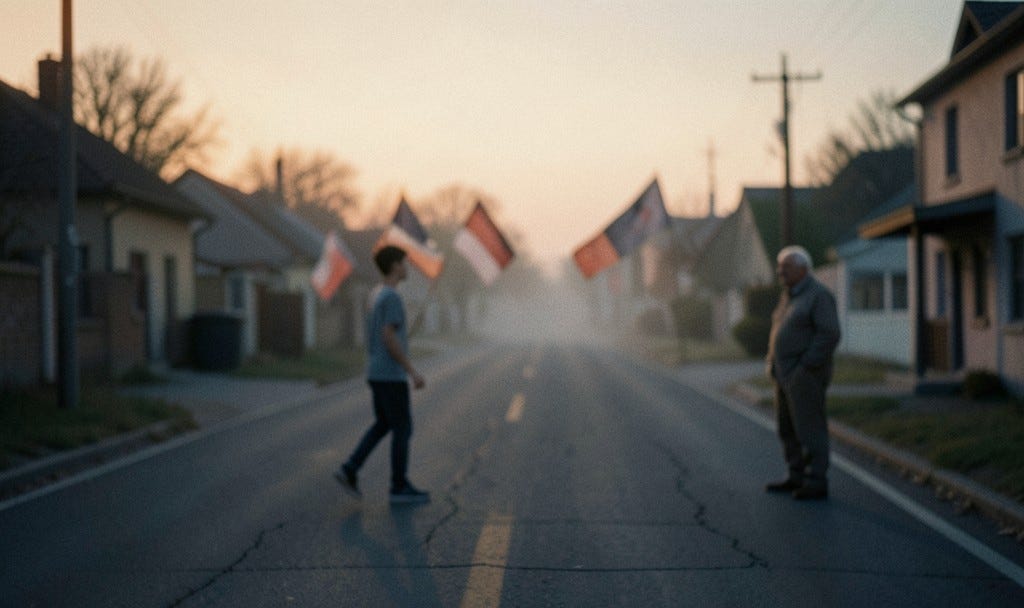
Around 20 years ago, my mentor and I were walking down the road after our usual evening walk, discussing life, career, and everything in between. A few people with flags marched past us, chanting anti-government slogans.
My mentor stopped walking.
“Do you know what they’re fighting for?” he asked.
“Something about the land acquisition, I think,” I said.
“You think,” he repeated. “Do they know?”
I looked at the marchers. A boy at the front, maybe seventeen, was shouting the loudest.
“Ask him,” my mentor said.
“Ask him what?”
“Whatever you don’t know.”
So I walked up to the boy. He stopped mid-slogan, surprised.
“What happens if the government agrees to your demand tomorrow?” I asked him.
The boy blinked. “Then... we win.”
“And then what? What changes for you tomorrow morning?”
He opened his mouth, then closed it. Someone behind him shouted the slogan again, and he turned back to join them, the question left standing there unanswered on the road.
My mentor hadn’t moved when I came back.
“The boy didn’t know,” I said.
“Neither do most people,” he said. “They aren’t foolish. Somebody handed them the slogan before they were old enough to ask for it. A father hands his son a religion. A teacher hands his student an opinion. A crowd hands a boy a chant. And it keeps moving, from one hand to the next, and nobody in the chain ever stops to check if it was true to begin with. Nobody questions what’s passed on to them.”
“So what do we do?”
My mentor looked at me for a moment, then smiled. “You question everything. Don’t believe it just because someone asks you to.”
“That’s it? That’s the entire answer?”
“It’s the only one that matters,” he said. “Question everything, and you’ll find your own answers.”
I didn’t fully understand it then. But once I started questioning everything that was passed to us by our families, societies or governments, I saw how much of it was obsolete. How much burden people carry from the past without knowing why. How much the present problems are just the past, unquestioned, repeating itself.
Which is why, sitting in that studio with young minds looking at me for an answer, I finally knew what I would tell my father too.
***
“So, which is it? What’s your answer?” The interviewer leaned toward me.
For a second I was back on that road, twenty years ago, watching a boy’s mouth open and close with no answer in it. Then the studio lights pulled me back.
“Question everything,” I said.
The studio went quiet, the way the road had gone quiet twenty years ago.
“That’s not an answer,” the first panelist said.
“It’s the only one I’ve got that isn’t borrowed from someone else,” I said. “My mother didn’t choose her beliefs. She was handed them. Neither did my father choose his. Ask yourselves twice where yours came from, and you might find the same.”
Nobody on the panel replied.
Quiet Clarity: Question everything you were handed. Only then will you know what you actually believe.
Reflection : Pick one belief you hold strongly. Ask yourself honestly: did you arrive at it, or was it handed to you?
P.S- This is story 3 of a series I call Modern Clarity, five true stories on what still matters. New ones land here every Saturday.
From Struggle to Strength
Genres: Non-Fiction, Non-Fiction / Health & Well Being, and Non-Fiction / Self-Help
